



Matomo reliably counts how often each page is viewed. The more interesting question is a different one: which paths lead to an enquiry or an order, and where do visitors drop out? These paths are the customer journey. Knowing them tells you which content carries weight, which channels bring new visitors and which ones close the deal.
What a customer journey includes
A customer journey is the path from the first contact to the goal. It has two levels:
- Across several visits: a visitor comes through an ad, reads a guide, returns a week later through the newsletter and finally orders directly. Each visit has its channel.
- Within one visit: from the entry page through pages and events such as a started video or a sent form to the goal or to the exit.
The first level requires Matomo to recognise the visitor. Matomo always sees the second, even without cookies.
Why you should know the paths
- What carries weight: which content and pages lie on the paths to enquiries and orders, and which only on paths that lead nowhere?
- Where visitors leave: at which step does a large share drop out, for example between product page and cart?
- What each channel does: some channels bring new visitors, others close. If you only look at the last contact, you may cut the channel that brought the customers.
- What is worth it: instead of improving ten pages by gut feeling, improve the two that most conversions pass through.
What Matomo shows itself
Matomo has a few reports that show parts of the journey:
- Transitions: for a single page, where visitors came from and where they went next.
- Visits and days to conversion: in the goal reports, how many visits and days passed before the conversion.
- Visitor profile: all visits of a recognised visitor in sequence. This is analysis of individual people and usually requires consent; the legal assessment stays with your legal advisers.
For visitor flows there is also the premium plugin Users Flow in the Matomo Marketplace. This page is about the paths to your goals and orders.
Visit Journey: the paths to the goal, without predefined steps
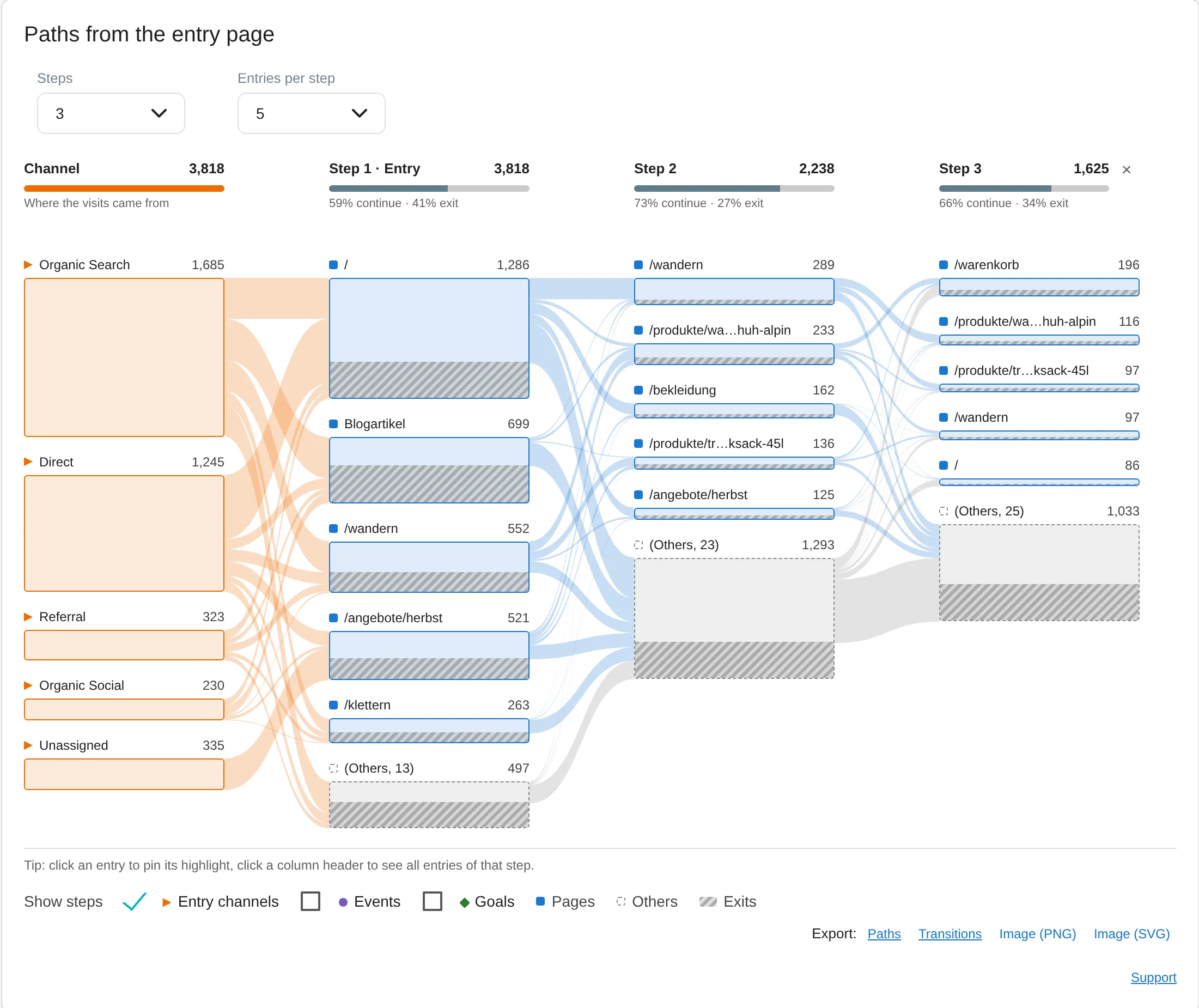
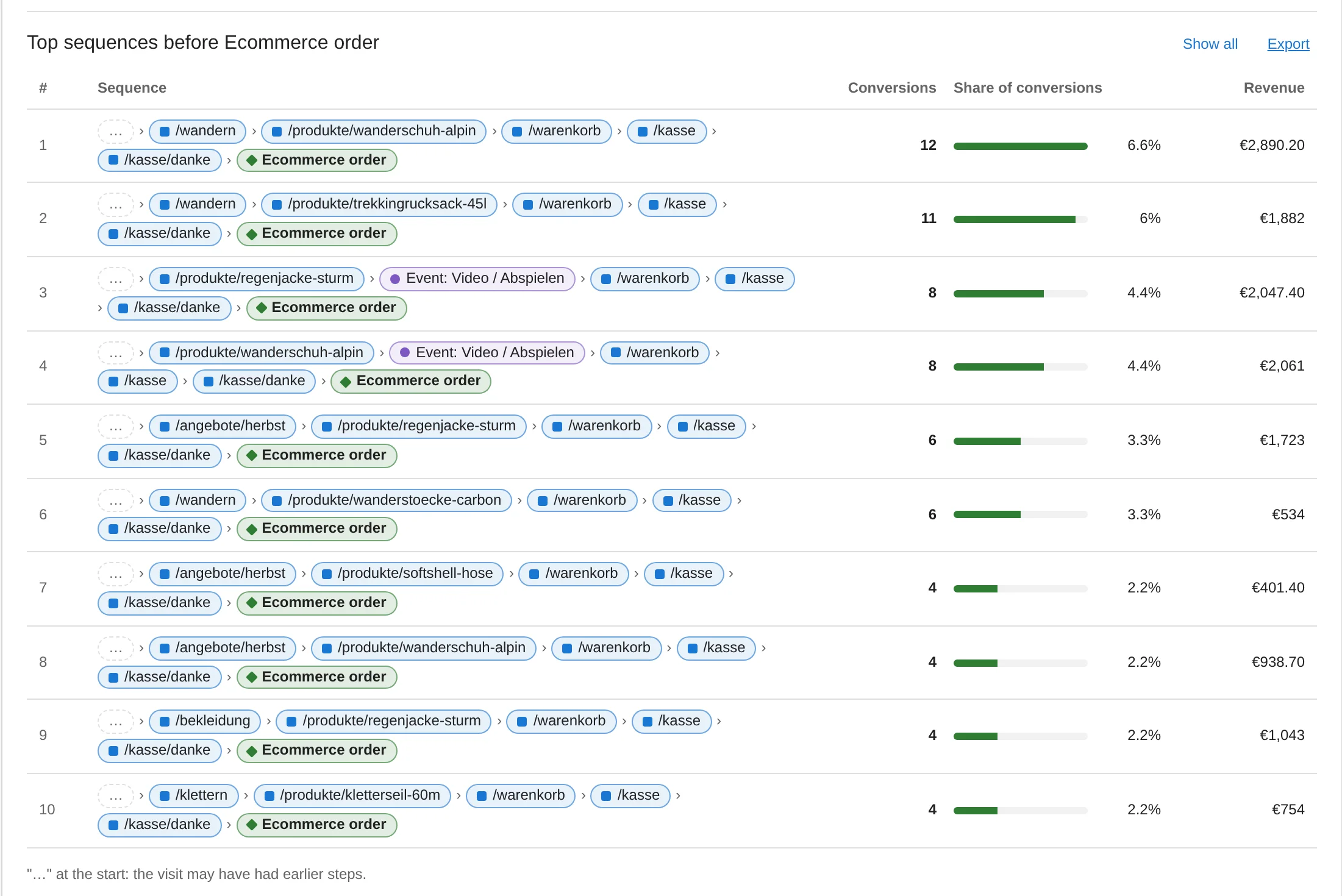
A classic funnel needs predefined steps and only shows paths you already know. Feinwerk Visit Journey works the other way round: it shows which steps really came before a conversion, as a flow diagram in Matomo under Behaviour > Visit Journey. A path runs from the channel and entry page of a visit to its last step.
- Paths from the entry page: where visits go after their first page, step by step, with the share that continues or exits. The channel stands before the entry page.
- Paths to the goal: for every goal and every order the steps before it, counted backwards from the goal, plus the most frequent sequences with conversions and revenue.
- Events and goals as steps: a video start or a form event appears between the pages once you release its category. Product pages can be grouped into one entry by a rule.
- For dashboards and export: both diagrams are dashboard widgets. You export paths and transitions as CSV and the diagram as an image (PNG or SVG), and BI tools fetch the data through the API.
Assigning channels cleanly
A journey is only as good as the channels in it. Out of the box, Matomo knows broad channel types such as search engines, websites, campaigns and direct entries. Whether a visit came from a paid ad, a newsletter or an AI assistant is often hidden in referrers and campaign values that first need to be grouped.
Feinwerk Channel Grouping assigns each visit to a channel according to your rules, optionally with a default grouping modelled on Google Analytics 4. It recognises click IDs of ad platforms even without campaign parameters, and with Visit Journey exactly these channels appear in the paths. Across several visits, its attribution reports credit a conversion to the last non-direct channel or the first channel in the 90 days before.
How campaign links arrive cleanly is covered in Campaign tracking.
The data the analysis needs
The paths are only as meaningful as the data behind them. Four building blocks decide:
- Goals and ecommerce. Without clearly defined goals there are no paths to the goal, only page views. How goals are built from events is covered in Event tracking.
- Events with a convention. Only events with meaningful categories and actions become readable steps.
- Channels and campaigns. A naming convention for campaigns and clear channel rules keep the first column of the journey right.
- Recognition across visits. For the level across several visits, Matomo has to recognise the visitor: with a cookie after consent or with a User ID after login. Without cookies, the analysis stays within the single visit. What this means for your numbers is covered in Unique visitors and Matomo without cookies.
A journey that holds up
- starts with the goalsEnquiry, order, download are clearly defined.
- shows pathsSequences instead of the ten most visited pages.
- knows its channelsRules and a campaign convention keep the first column clean.
- is honestAcross visits only with recognition, otherwise within the visit.
Typical pitfalls
- Page views instead of goalsThen the journey shows movement, but no result.
- Every event a stepScroll and technical events clog the paths.
- Channels in a muddleutm_source=Newsletter and newsletter tell two stories.
- Paths across visits without recognitionWhat is not recognised cannot be connected.
Sources
As of 12 November 2026, Matomo 5.14 and 6.0.0-rc1